
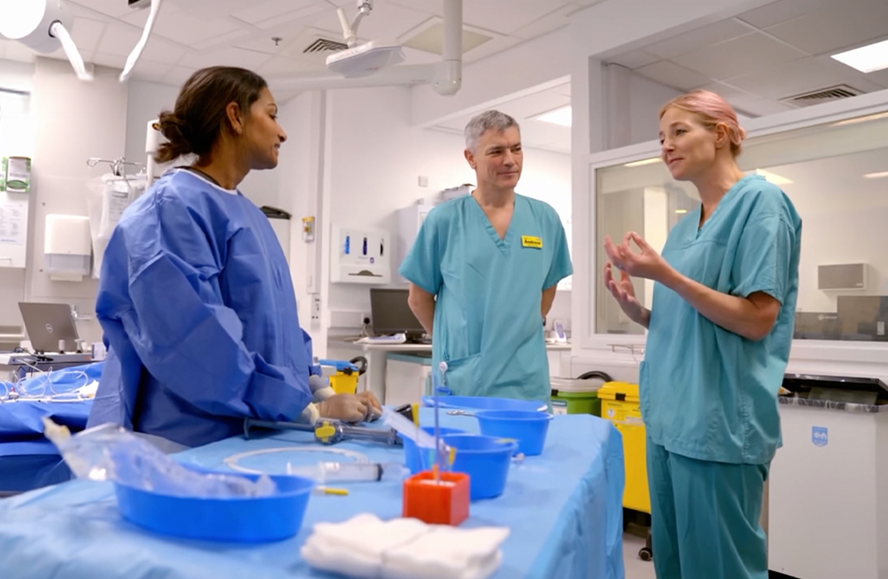
Prior to the broadcast of Alice Roberts: Our Hospital Through Time, the 5 press team sat down with Professor Roberts (pictured [right] at Barts) to preview the documentary.
 What makes this a pertinent time for a 6-part documentary on Barts?
Barts recently celebrated its 900 years anniversary. It’s just astonishing to think that it’s been going for that long as a hospital. It is the oldest continuously operating hospital in Britain on the same site. It had its funding taken away in the middle of the 16th Century, but it limped on. Eventually it was re-founded. I find it incredible that we have got this hospital today which is still on the same site as the Norman hospital from the 1100s. What is extraordinary about this series and what really does mark it out from anything I’ve seen about medicine and the history of medicine on television is that we are covering the contemporary hospital, modern treatments with modern patients going through those treatments and we are exploring a lot of history that is Barts history. The hospital trust holds an incredible archive on site. I am a medic originally and fascinated with history, so I was in my element completely. So many pioneering advances were made at Barts and by Barts doctors and Barts surgeons.
When was the first time you visited Barts?
My first time was making this series. I’ve walked past it many, many times. I’m not a Londoner myself so I have never had a reason to be there clinically. What is extraordinary about it is that it covers an area of about seven acres. You pass through an 18th Century façade to go into this enormous space, which is the modern hospital. All the wards and operating theatres are there. It’s quite Tardis-like. From the outside you don’t realise the scale of it at all. I had fun looking at old maps trying to work out where the medieval hospital relates to what’s there today.
What was the pioneering plastic surgery by Barts trained surgeon Harold Gillies in World War I?
Anyone that is interested in plastic surgery will have heard of Harold Gillies. He was an extremely pioneering and brave surgeon who was particularly interested in facial reconstruction for soldiers who had returned with dreadful disfiguring injuries to their faces. What was extraordinary is that a lot of his techniques are still being used today. I was talking to Nicholas Bennett, a plastic surgeon who volunteers at the Royal College of Surgeons, and he was able to really contextualise that and talk to me about the different methods and procedures that Gillies was developing. One of the interesting things about the whole process of facial reconstruction is that it is not a single operation. He planned his operations very carefully and you sometimes go through stages where people look worse. Obviously, that would have involved some very careful counselling at the same time as these young men were going through these operations. We have photographs of the process and his notes. I was able to look at his notes and he is very self-critical. He really, really cares about restoring confidence. Reconstructing someone’s face so that they can feel happy to be out in society again.
The process was interesting. A lot of it is about moving flaps of skin around. You can’t simply take a piece of skin and then move it somewhere else on the body. Skin is a piece of a living organ, so it needs to have a blood supply. What Gillies was doing was freeing up a section of skin that still had the blood supply entering it and then moving it as far as he could so that the blood is still flowing into it. Then he had to think about things like whether the flap needs to be a bit bigger because it might shrink over time or whether it needs to be a bit smaller because it is likely to grow when it gets re-vascularised. It is very, very complex.
Are there interesting comparisons to be made between how Barts treated the Great Plague victims in 1665 and treatment during the 2020 Covid pandemic?
We tend to think that people in the past didn’t have a clue about infection. Certainly, before the invention of microscopy we didn’t even know germs existed. But they did have some idea of contagion. At Barts what was interesting to read in its records was the principle of isolation. If they thought someone had a contagious disease, they were not admitted to Barts in the city. They were sent to the hospital’s out-houses. We had a similar thing going on in our hospitals during Covid where, yes, Covid patients were treated within the hospital but sealed off as much as they could be from the rest of the hospital so that we could try to keep our hospitals going in terms of the more routine operations and emergency operations. Obviously, we have a much better idea of how infection spreads today. I don’t think it meant that we dealt with that contagion particularly well. If you think about it, for that first year, apart from Intensive Therapy Units for patients who were extremely badly affected by Covid, we were dealing with it in quite a medieval way. Essentially the only way to combat this disease was a physical way, through isolation and the use of barrier methods, which were available in the Middle Ages. It is remarkable though that we developed a vaccine in a year. That’s the equivalent of putting a probe on Mars. It is incredible what we can do with science nowadays – if we fund it.
What did you learn from historian Ruth Goodman about the hospital’s laundry methods in the 1700s?
We had great fun with an enormous tub. I was amazed that one woman could wash all this laundry but when I saw the size of the tub, I thought ok you probably can! I was very interested in the chemistry of it and the fact that they would be using wood ash to create something called lye, which is an extremely strong alkaline. This interacts with the oils that are on the sheets and the rags that are being washed and does act as an extremely effective detergent.
Can you describe the experience of visiting the Old Operating Theatre and participating in a re-enactment of a limb amputation without anaesthetic?
That was quite shocking. I was with the historian and education manager at the Old Operating Theatre Alannah Gilmour. It is a fantastic place to go to learn more about the history of medicine. It’s open to the public and it has a wonderful herb garret as well. Alannah took us through the process of amputating a limb going back to days before anaesthetic. It’s interesting doing those re-enactments. There is something about going through the process and imagining what it would have been like that is very visceral and quite harrowing. It’s not for the faint-hearted.
I was also looking at descriptions of pre-anaesthetic operations, which were very gruesome to read. They describe the patient being awake at the time with physical restraints. You are employing a whole team to hold the patient down while they are subjected to this pretty horrendous operation. The skill of the surgeon is once you are starting to cut into somebody you have got to try to do it as quickly as possible for the sake of the patient. One of the main problems is blood loss. You’ve got to know your anatomy. Even in those days before we had modern surgery, modern anaesthesia anatomy was such a fundamental discipline. You’ve got to know where those big arteries are before you hit them. It’s incredible especially in the days before antibiotics if you are amputating a limb for an infection this really could have been a lifesaving operation.
What was it like reading Barts most famous physician William Harvey’s first edition handbook on blood circulation and then becoming a human guinea pig for some of his experiments?
It was amazing to go into the Royal College of Physicians and to be allowed to handle this incredible book on the motion of the heart and the blood in animals. Harvey had done dissections and he had also done vivisections. It’s always difficult history when we are thinking about how people were acquiring this knowledge. Then he did less invasive experiments on burly men with big veins. There are lovely illustrations where he has put a tourniquet on an arm. The veins will fill up because the blood can’t flow back up your arm. Then you can put a finger on a vein, push the blood towards your hand then lift your finger and see which way the blood is flowing.
You can put up Harvey as being the hero who discovered how the circulation works but of course there were many, many people who contributed to this discovery eventually. What Harvey did was work out that you have this circulation of the blood with effectively two circulations. The human heart has two sides to it. One side is pumping to the lungs to pick up oxygen and bringing that blood back to the heart. The other side is pumping it around the body. That is so fundamental to understanding the heart and the circulation. It’s interesting because these doctors are all doing operations, treating patients, but they are also very interested in pushing the understanding of the body further. We still find that today. Plenty of the surgeons and the other doctors that I talked to are still pushing at the envelope of what we understand about the human body.
What was the role of the Beadles at Barts?
I’m wandering around London back then and stumbling across various waifs and strays and people who may need to be admitted to hospital. The role of the Beadle was to go out into the community and actively look for patients. Rather than waiting for patients to refer themselves, they were tasked with finding patients for the hospital. The motivation for this is outlined in the Refoundation Charter; it was a public health measure, with an additional role in maintaining social order, reflecting contemporary fears about rising levels of poverty and vagrancy following the dissolution of the monasteries, which removed the old system of social care. I think that the governors of the hospital were delighted to think that they were helping poor people in London. But they were also delighted to be ‘tidying up’ London by literally removing these people. It’s quite well articulated, even going back to the foundation of Norman hospitals. The role of a Beadle was put in place after the re-foundation of the hospital when Henry VIII effectively gave Barts its funding back, having previously taken the property after the Reformation and the dissolution of the monasteries.
What is the key role that perfusionist Peter ‘The Pump’ Reeves plays in a patient’s open-heart surgery?
Barts is a world-leading cardiac centre. Some of the operations that are done there are mind-blowing. With operations on the heart, it was interesting because I saw both extremes. I saw interventional cardiology where people are effectively having operations on their heart, but it is being done remotely through catheterisation. And then I saw operations where you do have to open somebody up. Now you can’t operate on somebody’s heart if it is working. It is constantly beating and contracting, and it is full of blood. Some of the operations I watched involved surgeons opening the chest, and to operate on someone’s heart you have to replace its function completely with an incredible piece of equipment called a heart–lung machine.
You are essentially diverting the blood out of the patient’s body. You are oxygenating it. You are doing the job of the lungs as well. And you are then pumping it back into the body. You are bypassing the heart completely. Then you can use anaesthetics effectively to stop the heart and do your operation. It’s incredible. That’s an operation just to create that cardio-bypass. That then allows you to operate on the heart. The surgeon can’t operate unless Pete the Pump is there doing his job as the perfusionist.
What impressed you most about the restoration work in The Great Hall at Barts?
The Charter window is beautiful. It’s a glowing jewel of a window. It commemorates the refoundation of the hospital in the 16th Century when Henry VIII signed the new charter. There is Henry VIII handing over the royal charter to the Lord Mayor of London, to symbolise the handing over of the hospital to the City Corporation. And I saw the actual charter. That’s the amazing thing about this archive. They have this enormous charter with the wonderful big seal on it. That was in 1547. The window itself is nearly 100 years later. It was in the medieval hall which no longer exists. The medieval buildings were largely replaced in the 18th Century, but it was something that people thought was incredibly precious and needed to be preserved. I loved seeing the restoration. I was visiting the hospital over months, so I saw this process gradually coming together. They have restored everything: the sash windows, the amazing ceiling with beautiful gilding on it. There are Hogarth paintings as you go up this grand staircase to the Great Hall. I was up there with Dr Giampaulo Martinelli, a consultant anaesthetist. He takes students there to do tutorials that are art history and clinical observation. Getting them to look at all the patients and try to work out what various diseases they are suffering from. What I really liked is that the Great Hall used to be the space where the governors had their meetings and their posh dinners but now it is going to be about the public who are visiting Barts and the patients.
What have you loved most about making this series?
The main thing for me is I have not seen a series like Barts before. The fact that we have got the modern hospital, contemporary stories, but then also the history and branching off to look at that. I’m very proud of this series. It has been a great privilege to work with the medics and all the other staff that I met at Barts and the historians. I hope that we might go back because there are more stories to tell.
back to news post